The story of Nancy Bowen is a story involving witchcraft, a sexual predator, racism, the national press, and a broken judicial process. Bowen, a Cayuga and Haudenosaunee woman from the Cattaraugus Reservation of the Seneca Nation, was a healer and farmer known for selling sassafras alongside her husband, Charley, in Buffalo, New York. In 1930 she was tried for the murder of Clothilde Marchand. Clothilde had been married to Henri Marchand, a French sculptor and former student of Rodin who made figurative dioramas for the Buffalo Science Museum. (Clothilde was also an artist in her own right.) Henri was a known philanderer. He actually prided himself on seducing his models—“too many to count”—so they would disrobe for him. Issues of consent loom large.
Henri had an auxiliary studio in the Cattaraugus Seneca community, and it was there that he began an affair with a Seneca woman named Lila Jimerson, twenty years his younger. Both Henri and Lila were also suspects in Clothilde’s murder. According to several accounts, Lila involved Nancy Bowen in the crime by convincing her Clothilde was a witch who had killed her husband, Charley, but the story became so sensationalized that we will never know the truth.
Bowen ended up pleading guilty to manslaughter and serving a year in the Erie County jail. Prior to her trial, however, the media and judicial system demonized Bowen and proclaimed her guilty of the crime for being Indigenous, rendering her guilty in the court of public opinion and denying her the opportunity for a fair and just trial.
Nancy Bowen’s trial happened at a moment in which Buffalo was one of the largest cities in United States, thanks to the Erie Canal. The region referred to as “Buffalo” is part of the traditional territory of the Seneca and Haudenosaunee people. There was an active attempt to erase the Indigenous presence in Buffalo at this time.
This project aims to revise Nancy Bowen’s story and place it in the context of what is happening today. Her story connects to our present moment, to the story of George Floyd and others who’ve directly experienced death, incarceration, and familial and community trauma as a result of entrenched racism. Her story also speaks to current cases involving missing and murdered Indigenous women, and the way they are not given urgency or agency by law enforcement or the press—a statistically high proportion of these remain cold cases that receive little to no follow-up.
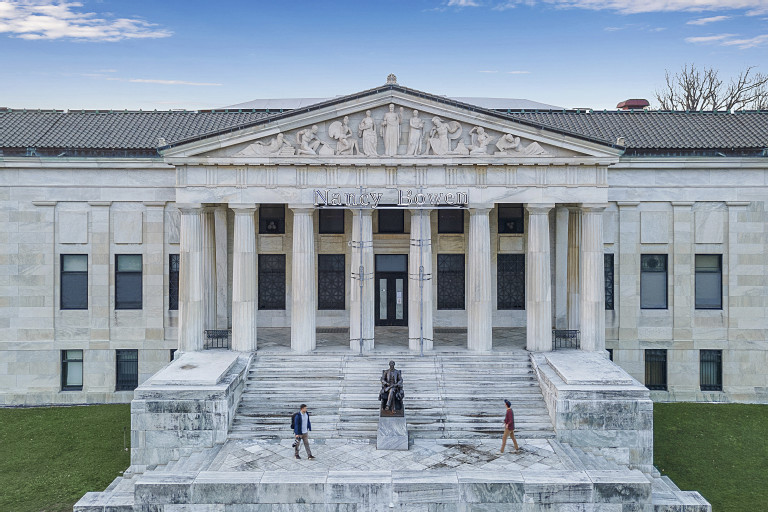
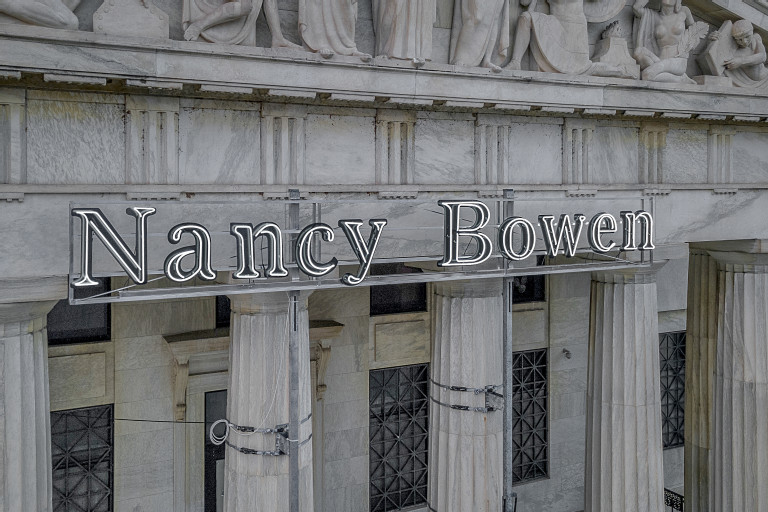
The project includes two neon signs spelling out Nancy Bowen’s name. How does saying Nancy Bowen’s name create awareness of the racism that led to her 1930 conviction in the court of public opinion before she was tried? How does saying her name invite us to witness the names of other people, over time and up to this moment, who have been wrongfully judged?
This sign hangs on the exterior façade of the Buffalo History Museum, which was built for the 1901 Pan-American Exposition, in which one of the main attractions was electric light. Buffalo, nicknamed the “City of Light,” was one of the first cities in the world to have widespread streetlights, powered in this case by Niagara Falls.