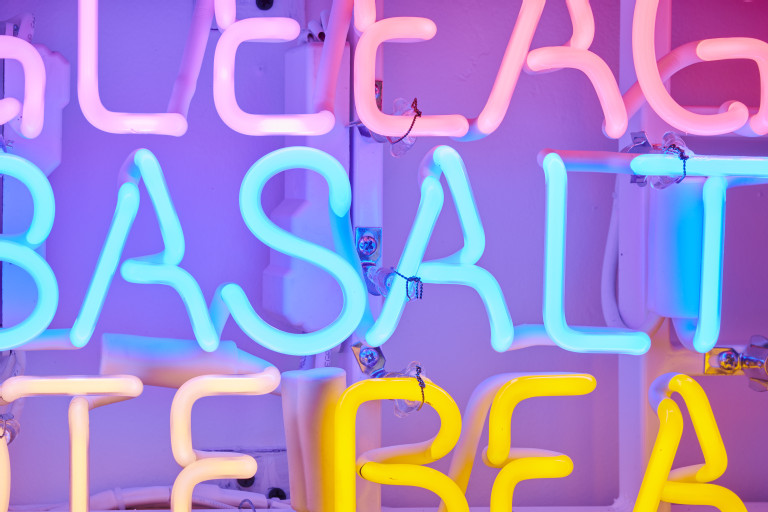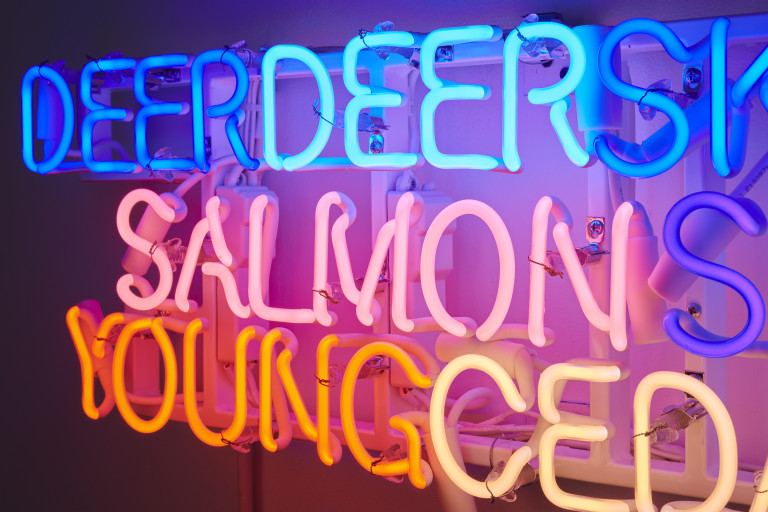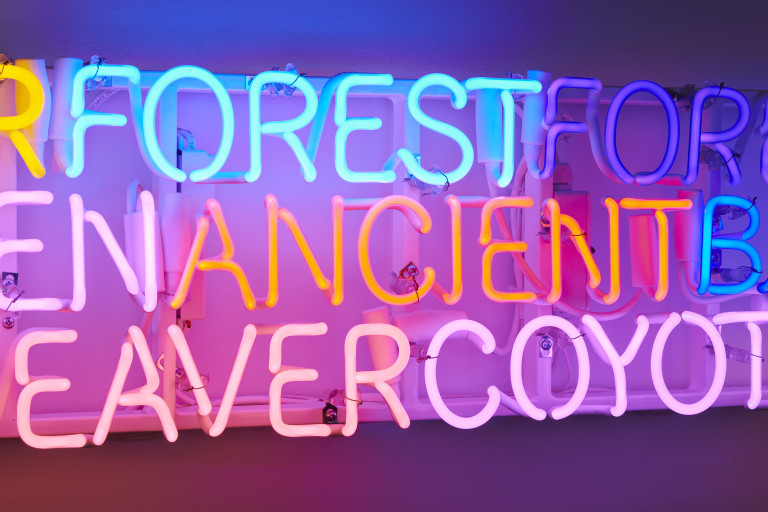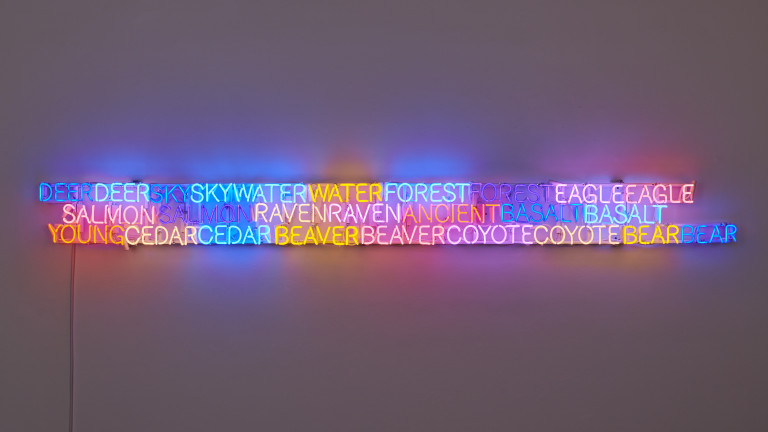
Shared Horizon (Keepers of the Western Door) is an evolution of my work exploring twinning language, neon, and light on the horizon.
In the Haudenosaunee community, the Seneca are considered Keepers of the Western Door, just as the Mohawks are the Keepers of the Eastern Door. The use of “Western Door” in this title also acknowledges my experience of growing up in the Pacific Northwest.
The twinned language references the animals, plants, elements and histories that inform my experience and understanding of many Wests. Doubled, the words call backward and forward to ancestors and future generations, each other and the viewer.
For me, neon is an extension of beadwork. The glass itself is at once a thread and bead. Like beadwork and textile work, neon is part of a long craft tradition. In an odd way both beads and neon have a relationship to trade; beads historically as currency, and neon as a sign to advertise a business. I am drawn to how both beads and neon have dazzling relationships with light, reflected and refracted. While neon has a history of expressively adorning buildings, beads have a strong history of expressively adorning bodies as regalia (clothing, accessories, jewelry).
In her poem “Singing Everything,” US Poet Laureate Joy Harjo muses on remembering our connectedness to land, death, horizons, birth, love, and heartbreak. It’s a meditation on remembering to remember. Harjo observes that while we used to sing a song for every occasion, we no longer sing to honor these life events the way we once did as both individuals and communities. In the poem she evokes sunrises. I began thinking What is a sunrise? How does it connect us? I’m fascinated by the sunrise—how the sunrise is not the same as sunset; how the quality of sunrise is different from East to West. The colors in this piece are meant to bring to mind the colors, temperature, and elements that play at the horizon as the sun moves. I am struck by the fact that somewhere, right now, the sun is rising or setting, and this is an experience we all share.